Kura
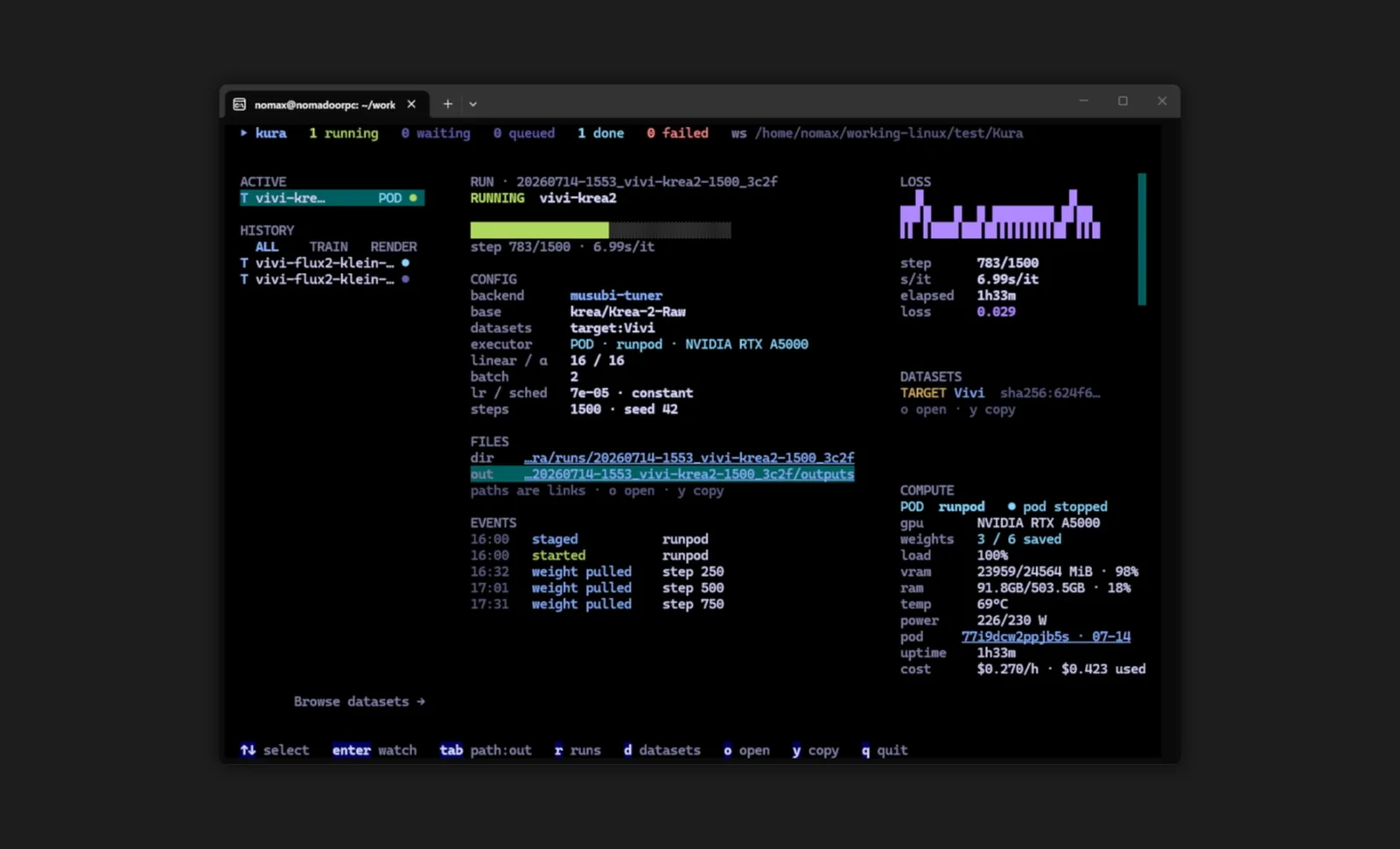
We released Kura, a workspace for training LoRAs for image generation models together with an AI agent. People focus on datasets and parameters, and the agent takes on the work of running the training. Every result is recorded and used for the next training run.
Focus only on what needs thought
What really needs thought in making a LoRA is which dataset to prepare and which parameters to train with, and nothing more. In practice, though, most of the time goes to setting up each trainer's different environment, writing its settings, watching the training, and sorting out the results. A good LoRA rarely comes from one run; it takes many, so that effort is repeated each time.
Today that effort can be handed to an AI agent. But having an agent build the environment from scratch every time is wasteful, and what was tried is left nowhere. We built Kura to give the agent the tools to run training reliably and a place to keep what was tried, so that people can focus on datasets and parameters.
Works the same for everyone
Each trainer comes with an environment in which it has been checked to work. Because it doesn't depend on your own setup, it works the same whoever uses it and whichever AI runs it.
Stopping time-wasting mistakes early
LoRA training can take days. If a mistake in the dataset or settings only shows up after training, all that time is lost. Kura checks the plan before training starts and stops mistakes that would waste that time.
Knowledge that builds with every run
In Kura, the settings, the results, and the evaluation of the person who looked at them are all kept as files. When the agent plans the next run, it reads these records and makes its proposal based on what to change from last time and how the last run was judged.
Until now, what people learned about making LoRAs stayed only in their heads or in conversations that scroll away. In Kura, it accumulates as files with every experiment and is put to use in the next run.